
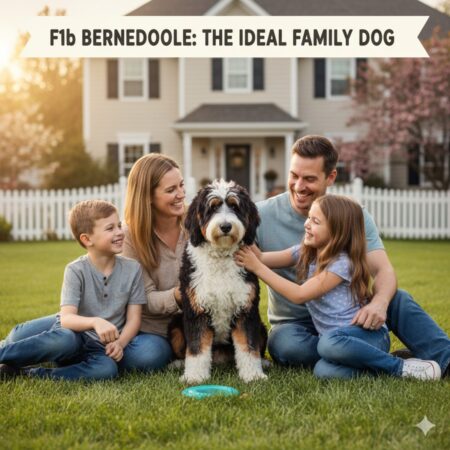
In Depth Guide About F1b Bernedoodle The Perfect Family Dog
Oh hey! So you’re thinking about getting a dog and you’ve heard the buzz about F1B Bernedoodles right? Well, you are definitely not alone as these fluffy, friendly pups have been stealing hearts left and right, and for good reason. Without further ado, let me walk you through why so many families are falling head over paws for them.
All About Bernedoodles
Bernedoodles are a cross between a Bernese Mountain Dog and a Poodle basically, the best of both worlds. They’re smart, sweet, and usually low-shedding which makes them great for families and allergy sufferers.
They come in three sizes: Mini (25 to 45 lbs), Medium (40 to 60 lbs), and Standard (70 to 90+ lbs), so there’s one to fit every lifestyles.
Known for their gentle, goofy, and loyal personalities, they’re amazing with kids and love being part of the family. They’re easy to train (thanks to Poodle brains!) but need regular grooming like brushing a few times a week and professional trims every 6 to 8 weeks.
They live 12 to 15 years and are generally considered healthy, and thrive on attention and companionship.
Just know that they’re not low-maintenance, and they hate being left alone too long. But if you want a loyal, lovable, teddy-bear-like dog who’s always by your side? A Bernedoodle might be your perfect match.
Bernedoodle Health issues
Bernedoodles are generally healthy, but they can inherit issues from their parent breeds. Common health issues include hip and elbow dysplasia, progressive retinal atrophy (PRA), allergies, and bloat especially in larger dogs.
They may also be prone to Von Willebrand’s disease, a blood clotting disorder. But a regular vet checks, proper diet, exercise, and buying from a responsible breeder who tests for these conditions can help keep them healthy.
Bernedoodle Miniature Size
A Miniature Bernedoodle typically weighs 25 to 45 pounds and stands 18 to 22 inches tall at the shoulder.
READ ALSO: Why Do Cats Meow? Your Cat Maybe Saying Something
What Is an F1 Bernedoodle?
An F1 Bernedoodle is the first generation of this beloved designer breed created by crossing a purebred Bernese Mountain Dog with a purebred Poodle (usually standard, but sometimes mini or medium).
This 50/50 mix gives them a unique blend of traits: the Bernese’s gentle, calm, and affectionate nature, plus the Poodle’s intelligence, trainability, and low-shedding coat.
F1s often have wavy to slightly curly coats that shed less than a pure Bernese but may not be fully hypoallergenic. Grooming is still important like brushing a few times a week helps prevent mats.
They’re known for being friendly, balanced, and great with families. Because of their genetic diversity, F1 puppies in the same litter can look quite different—some may favor the Bernese, others the Poodle.
F1 Bernedoodles come in mini, medium, and standard sizes, depending on the Poodle parent used. Most live 12 to 15 years and are generally healthy, though they can inherit conditions like hip dysplasia or bloat.
All About F1B Bernedoodles & Their Unique Characteristics
Genetics: 75% Poodle, 25% Bernese Mountain Dog (F1 Bernedoodle × Poodle)
Coat: Curly or wavy, low-shedding, often hypoallergenic, great for allergy sufferers
Colors: Tri-color (black/white/rust), black & white, red & white, sable, phantom, or merle
Temperament: Intelligent, affectionate, eager to please, highly trainable, and social
Family-Friendly: Gentle with kids, good with pets, thrives on human connection
Sizes: Mini (25 to 45 lbs), Medium (40 to 60 lbs), Standard (70 to 90+ lbs)
Exercise Needs: Moderate like 30 to 60 mins daily of walks, play, or training
Grooming: High brushing like 2 to 3x/week, professional grooming every 6 to 8 weeks
Health: Generally healthy; watch for hip dysplasia, bloat, PRA, allergies
Lifespan: 12 to 15 years with proper care
This perfect family dog is a perfect mix of brains, beauty, and big-hearted charm.
F1B Bernedoodle Lifespan
F1B Bernedoodles typically live 12 to 15 years, with some reaching up to 16 years. Their lifespan benefits from hybrid vigor, but depends on genetics, diet, exercise, and regular vet care.
F1 vs F1B Bernedoodle: Key Differences Explained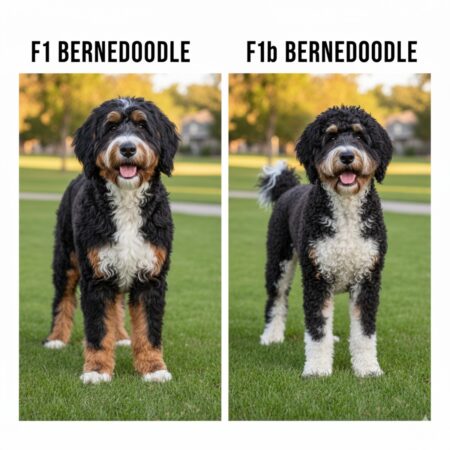
1. Genetics
F1: 50% Bernese Mountain Dog, 50% Poodle
F1B: 75% Poodle, 25% Bernese (F1 × Poodle)
But the F1B has stronger Poodle genes, which affects coat, shedding, and trainability.
2. Coat Type
F1: Wavy to loose curl: “shaggy teddy bear” look
F1B: Tighter curls: more like a Poodle or “fleece coat”
The F1B coats are curlier and softer; F1s have a more varied, wavy texture.
3. Shedding & Allergies
F1: Moderate shedding, not fully hypoallergenic
F1B: Low to no shedding, highly likely to be hypoallergenic
F1B is the top choice for allergy-sensitive homes.
4. Grooming Needs
F1: Brush 2 to 3x/week; groom every 8 weeks
F1B: Brush 3 to 4x/week; groom every 6 to 8 weeks (more prone to matting)
F1B requires more frequent care due to curlier fur.
5. Temperament
F1: Balanced, calm, gentle, slightly more Bernese-like
F1B: More Poodle-like, highly trainable, eager to please, slightly more alert
Both are friendly and family-oriented, but F1B tends to be more responsive in training.
6. Appearance Consistency
F1: Higher variation puppies in the same litter can look very different
F1B: More uniform especially in coat and coloring
F1B litters are more predictable in looks.
7. Best For
F1: Families wanting a low-moderate maintenance dog with a laid-back vibe
F1B: Allergy sufferers, those wanting a non-shedding coat, or owners who love Poodle smarts
In all, if you want less shedding & allergy-friendly then go for the F1B but if you want easier grooming & balanced traits then the F1 should be your choice. Both make amazing, loving companions, it just depends on your lifestyle.
What are The Generations of the Bernedoodles?
Below is a quick breakdown of the main Bernedoodle generations:
F1 = 50% Bernese × 50% Poodle
First cross; wavy coat, moderate shedding
Balanced temperament, good for families
F1B = F1 × Poodle (75% Poodle)
Curlier coat, low-shedding, often hypoallergenic
Ideal for allergy sufferers; higher grooming needs
F2 = F1 × F1
More variation in coat and traits
Less predictable than F1 or F1B
F2B = F2 × Poodle
Similar to F1B but with more genetic mix
Often low-shedding, but can vary
Multigen (F3+) = Multiple generations of Bernedoodle breeding
Most consistent in type, coat, and temperament
Often bred for specific traits like non-shedding
Each generation offers different benefits, F1B and Multigen are most popular for their teddy-bear look and allergy-friendly coats.
How To Care for An F1b Bernedoodle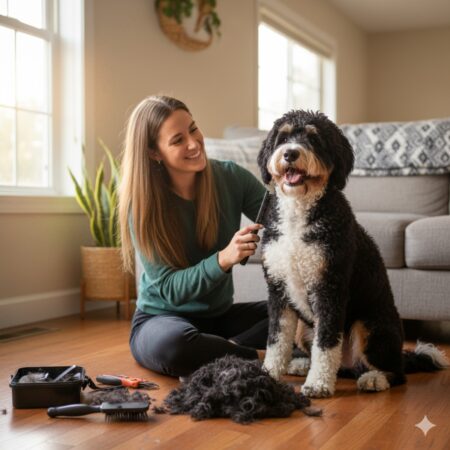
Caring for an F1B Bernedoodle means giving them love, attention, and a little extra grooming. Here’s how to keep them happy and healthy:
1. Grooming (High Priority)
Their curly, low-shedding coat needs brushing 2 to 4 times a week to prevent mats especially behind ears, under arms, and legs.
Get them professionally groomed every 6 to 8 weeks for a trim (teddy bear cut is popular!).
Bathe every 4 to 6 weeks with a mild dog shampoo to avoid dry skin.
2. Exercise & Mental Stimulation
They’re moderately active, aim for 30 to 60 minutes daily of walks, play, or training.
Add puzzle toys or trick practice to keep their smart minds busy. They love learning!
3. Diet & Nutrition
Feed high-quality dog food suited to their size and activity level.
Avoid overfeeding, Bernedoodles can gain weight easily.
Always have fresh water available.
4. Health & Vet Care
Schedule yearly vet checkups and stay on top of vaccines, flea/tick, and heartworm prevention.
Watch for signs of hip dysplasia, bloat, or allergies.
Choose a breeder who health-tests parents for genetic conditions.
5. Emotional Needs
F1Bs are people-lovers. They hate being left alone for long can develop separation anxiety.
They thrive on companionship, so include them in family life as much as possible.
6. Routine Care
Brush teeth a few times a week
Trim nails monthly
Clean ears weekly (they’re floppy and prone to infections)
READ ALSO: Why Do Cats Sleep So Much? 10 Reasons Why
In Conclusion
For families seeking a low-shedding, easy-to-train, and deeply bonded companion, the F1B Bernedoodle isn’t just a pet, it’s a true member of the family. But if you are thinking about bringing one home: do your research, find a reputable breeder, and get ready for a whole lot of joy. Because once you meet your F1B, you will wonder how you ever lived without them.
FAQs:
Which is better, F1 or F1B?
It depends on your needs but most families with allergies or wanting a teddy-bear look prefer F1B.
Are F1 or F1B Bernedoodles more expensive?
F1B Bernedoodles are usually more expensive than F1s often by a few hundred dollars and this is because they’re in higher demand (thanks to their hypoallergenic, low-shedding coats) and require an extra breeding generation. But prices can vary by breeder, location, and size.
What is the best kind of Bernedoodle?
F1B is often the top choice for families, especially with allergies.


